Guest Blog: Bill Bodden on Networking for Writers

Bill Bodden brings us the second post in the guest blogging series, on the topic of networking. Bill is a great writer and a really splendid guy whose story “In The Shadow of His Glory” is the dark heart of my first anthology, Sidekicks! 

It would be no exaggeration to say that 90% of the writing work I’ve had in the last five years has come through networking. To paraphrase the old saw, (in my case, at least) it really is all about who you know. I’m writing this from a writer’s perspective; pretty much everything applies, with only slight variations, to illustrators, editors, graphic design/layout professionals, the whole gamut of folks involved with publishing books.

As a freelance writer, I scour the web for open calls for fiction, but in truth, I somehow miss most of the ones I would be interested in. As a no-name writer, I very rarely get invitations to submit stories to anthologies. Besides the depressing work of sending out stories and waiting for the rejection letters, I’ve found that I can keep my writing skills sharper if I continue to work as a freelancer.

I’ve recently finished work on a couple of different table-top RPG projects, one of which I was recommended for by a friend. After I completed my assignment, I was given more work by that firm, so I must have done an okay job. I know the developer of the second project personally, and he very graciously farmed some of the writing work for this book out to me.

So how does one get to know people in positions like that? Buy them a drink at a convention. Chat with them; strike up a conversation about puppies or the stock market on aluminum siding – whatever. If they’re gamers, play games with them. Find something you’re both interested in and talk about it for a LITTLE while.

Remember your manners.

Also, remember that this isn’t all about you. Ask them questions about stuff they’ve mentioned; ask what they like to read. You know, carry on a conversation. If it comes up, mention some writing work you’ve done that’s appropriate, but absolutely don’t lead with that information; it sets an impossible standard for the rest of the conversation. If someone else introduces you and THEY lead with “This is Bob Schmalkald; he had a story in the anthology What the Hell Is This? by Editor X,” then go with that, but be prepared to move immediately on to talking about something else.

Then leave. Don’t follow them around from panel to panel; don’t barge in on their dinner party and expect to be invited along as they’re leaving for the restaurant. In short, try — try really hard — to NOT act like a stalker. Being memorable is good, but being memorable for not being a creepy, clingy jerk is much, much better. If you run into them later, great. Chat a bit more maybe, then go chat with someone else. Don’t monopolize their time, and know when to back off. If they happen to invite you along, great; they like you.

Remember your manners.

After the convention is over, friend them on Facebook OR Twitter OR Goodreads. Don’t friend them on all three on the same day – remember that warning about not acting like a stalker? Yeah. After a week or two has passed it’s probably okay to friend them elsewhere, particularly if you’ve been interacting.

Eventually, you’ll be networking without even realizing it, swapping business cards with editors, publishers, and other writers. This is good. It gets your name out there so people will remember you, and think of you when they have a project and need some help writing it. People will actually check out your work, and talk about it with each other. That part is the icing on the cake.

Perhaps the most important thing about networking is this: Deliver what is asked. There is nothing — and I mean NOTHING — that will get your name spread around faster than being on-time and on word-count for a project. If you sign a contract stating that you’ll have 50,000 words typed, double-spaced on 60-lb. linen paper by tomorrow, you’d better do exactly that. Read your contract and know what it means before you sign it.

And remember your manners.

***

Bill Bodden has been a freelance writer since 2002. Most recently he has had a story included in Sarah Hans’ anthology Sidekicks! from Alliteration Ink, and upcoming credits in the Achtung! Cthulhu Keeper’s Guide plus several as yet untitled projects. You can check out his work and his weekly blog at http://billbodden.com/

Guest Blog: Alana Lorens on The Importance of Critique Groups

For the next few months, I’m not going to have time to update my blog regularly. Rather than let it go fallow, I thought I’d hand it over to my friends and fellow writers so they could talk about…well, whatever they want that’s related to writing. To kick us off, here’s Alana Lorens. Alana is an accomplished author whose deliciously sinister story “A Recipe for Success” appeared in my editorial debut, Sidekicks! Today she wants to expound on the benefits of a good critique group. Take it away, Alana!

As a writer friend of mine scolded, “It may be fun to chunk out novel after novel, but until you put in the work to edit, they will never go anywhere.”

For me, it is in fact, fun to chunk out novels. I enjoy the process. I’ve won NaNoWriMo twice, creating a 50,000-word novel in thirty days. Over the years, I’ve written maybe twenty novel manuscripts. I had to wait till I was past 50 before I saw any published, though I have been blessed enough to see many of them come to the light—in fact, I received five contracts in 2010, three for fantasy novels, one for a romance and the last for women’s fiction; in 2011, two romance novels, a space opera and a fantasy, as well as a paranormal mystery; last year, a YA post-apocalyptic series, a romance novella, a space opera, and a romantic suspense, as well as a spooky short story for an anthology, and set so far for 2014, another space opera, vol. 2 in the YA series and a straight suspense. What has made the real difference for me is my critique group.

My personal editing process is stimulated, challenged and greatly aided by a talented critique group I met through Pennwriters. I can’t stress enough the value of a good critique group for any writer. While your mother/partner/daughter may rave about the wonders of your manuscript, if you’re serious about editing for the reading public, you need critical eyes of a variety of sorts. Our group, which meets every Thursday, is a veritable mashup of varied bodies of knowledge; a retired police officer, a therapist,  a lawyer, an artist, a technical copy writer, a barista, some students, some working, some retired–all gifted. Many are published in short form, in newsletters, newspapers, or short story. The group boasts three published novelists, though others are coming up close behind.

This brings me to my first point: find a critique group at the level you need. If you’re just starting out, you’re still learning about everything—grammar, rhythm, metaphors—and need to become comfortable with the use of words on the page. What you don’t need in a critique group is a bunch of snippy professionals who will tear your piece apart as soon as you share it. You need a group with other beginners and a few mentors, a group that runs exercises each week to help you grow as a writer. Hold out for that group.

Conversely, if you’ve been writing some time and you’re ready for publication, you need a group with some published writers in it, to learn about queries and marketing and how to set your work before the public. You’ll want some harsher critiques—in a constructive way! Hopefully, your writer’s skin has thickened to the point where you can hear some criticism of the work, but still understand how changes might make the work better.

My second point: ego has no place in critique groups, on either the writing or reading side. In order to get the most from your feedback, you should listen, not talk. When group members comment on your work, take in what they say. They might not be right. They might not understand what you meant by a particular phrase or scene. Arguing with them just shuts down their urge to help you. Frankly, if the scene is so unclear that they missed the point—maybe the scene is that unclear. If only one person missed it, but the majority got it, maybe it’s fine. Listen. Then decide.

As a person giving feedback, remember your ego doesn’t matter, either. A critique session is not where you score points for being brilliant. Your opinion of someone else’s work only matters as far as it improves the other person’s work. It’s their work. Constructive criticism helps; tearing someone to bits doesn’t. In a business where sheer persistence and will to continue is sometimes all that stands between a writer and publication, destroying someone’s self-confidence to prop up your own ego is criminal. It happened to me, more than once. Receiving scathing words from someone claiming to “help,” I decided to give up any hope of being a published writer. Thank the stars that my inner urges kept that from happening. Primarily because I found my new group.

What I like best about this group is the creative flow that works between us. Ego isn’t an issue. When we have questions, we toss them on the table, and they receive open, honest answers: Is this an information dump? Do you understand the character’s motivation? Is this too big a clue early in the story?

More importantly, in the discussion and exchange process, we’ve shared brainstorming moments that open the door to deeper understanding of my own work. What if your character did…? Perhaps the relationship between the girl and that boy could lead to…? What setting would make this scene most effective? What if the journey took on a more metaphoric flavor and…? I always love it when someone spots a meaningful undertone that I haven’t quite grasped, so I can coax it into the light.

Once you’ve worked over your manuscript with your group, then back to your computer to polish, polish, polish.

Though writing is a solitary process, editing can work best as a collective. I’d urge any writer to find a group, online or in person, that provides what they need. Be prepared to do your share to help others along the way ; keep your ego in check. And start chunking out those novels!

***

Alana Lorens dreamed for many years of being a spaceship captain, but settled instead for inspired excursions into fictional places with fascinating companions from her imagination that she likes to share with others. She has been a published writer for over thirty years, including seven years as a reporter and editor at a newspaper in Homestead, Florida, with a list of eclectic publications from horror to tech reporting to television reviews. She writes urban fantasy and science fiction under the name of Lyndi Alexander. The Elf Queen, her first novel, was released by Dragonfly Publishing in July 2010; the series continued with The Elf ChildThe Elf Mage and The Elf Guardian. She’s now working on the space opera Horizon Crossover series, and a YA trilogy, The Color of Fear—the first book, WINDMILLS, was published by Zumaya Publications this summer.  Writing as Alana Lorens, she produces romance and romantic suspense, including the Pittsburgh Lady Lawyer series, CONVICTION OF THE HEART, SECOND CHANCES, and the latest, VOODOO DREAMS, released by The Wild Rose Press in October 2013.

She is a single mother of seven, with two special needs children at home with her in Pennsylvania, and she volunteers at her local shelter for domestic violence victims, believing in every person’s right to be safe.

So this happened (squee)

Last night I went to a book-signing for Jenny Lawson (aka The Bloggess) in Dayton with my friends Corielle and Christina. I wanted to bring Jenny some taxidermy but didn’t because Reasons. Instead I brought her a copy of Sidekicks! (in which I wrote a ridiculously gushy little note about how inspirational and encouraging she has been for ladies like me–the sort with anxiety problems, the sort who want to be writers, the sort who are beyond goofy in a world that expects adults to be, like, serious or something.)

You know how, when you meet people you admire, sometimes it turns out really well and other times not so much? Well I guess I’ve been lucky, because the vast majority of the people I fan over have been completely lovely. Jenny Lawson was perhaps the loveliest of all.

Me: I brought you a present. It’s a book I edited.

JL: Oh my god, really? Thank you! Oh my god! Did you sign it?

Me: (turning pink) Yes, uh, on the dedication page, I wrote you a little note.

JL: I’m so glad you gave me this, now I’ll have something to read!

Me: It uh, just came out this weekend, so, there are no reviews of it yet, so I can’t be like “Neil Gaiman loves this book!” but, maybe someday?

JL: (opens the book to a page and reads for a few seconds) Okay well, now you can say that Jenny Lawson read part of a page and really liked it. So there’s that!

Me: You’re awesome. Can we take a picture?

JL: Of course! Hey why don’t we get a picture holding each others’ books?

Me: (trying not to freak out) OKAY

True Story. Thanks to Christina King for the photographic evidence.

JennyLawson

Advice from the Writer’s Symposium

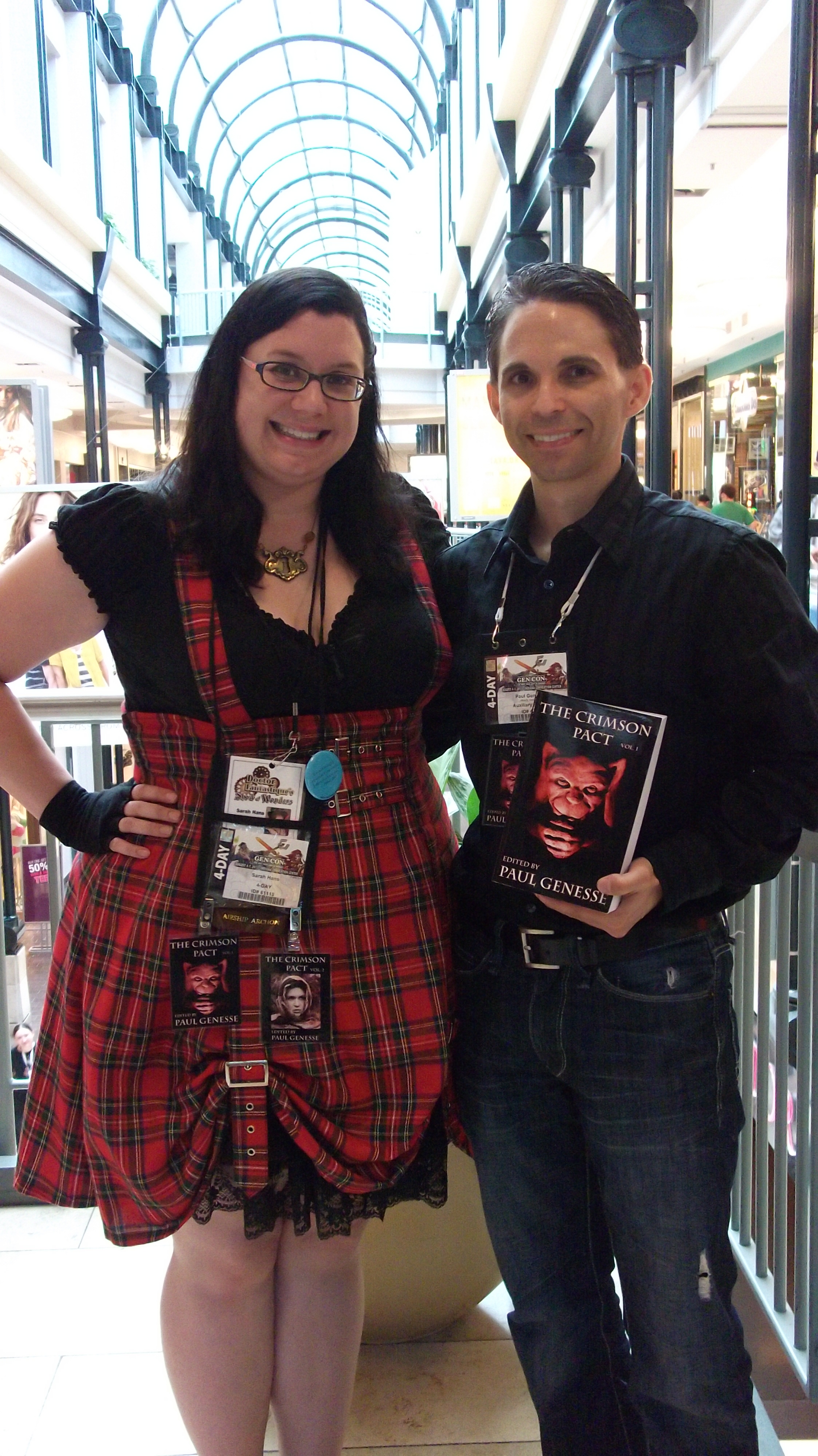
I spent four-ish days at the GenCon Writer’s Symposium last week trying to soak up as much advice from more successful writers as I possibly could. I plucked up my courage and introduced myself to Monica Valentinelli, who was about as lovely as a person can be to a random twitter fan pestering her in the dealer room. My work was critiqued by Marc Tassin, Kelly Swails, Wes Nicholson, and other accomplished authors. I finally got to meet Paul Genesse, the editor of The Crimson Pact, in person. My mentor Steve Saus introduced me to John Helfers, Maurice Broaddus, and so many others I can’t even keep them all straight. And I sat through about twenty seminars, taking notes and asking questions and generally trying to be a human sponge.

Meeting Paul Genesse at GenCon 2011

Something I learned about novels: Most first novels are never published, and many novelists have trunk novels stashed away that will never see the light of day. I’ve been waiting to write a novel until I’m “ready”, but the fact is that I have the luxury of time right now because I have a day job, and I shouldn’t waste that luxury. I can invest the time in writing a novel, knowing full well that my first one will probably never be published, without having to worry about lost income; I can just enjoy the writing, and learn about the process, and figure out what my novel-writing style is. I want very much to work on collaborative projects or shared worlds, but chances are slim that anyone will be willing to take a chance on an unproven commodity. I need to have a novel under my belt before anyone will take me seriously…so that’s now on my ever-expanding to-do list.  Honestly I’ve wanted to write a novel since I was a teenager, but it never seemed like the right time. Well, that time is now.  So look for posts about that in the near future.

Another thing I learned: I’m having a hard time finding the middle road between showing and telling. The old “Show, don’t Tell” adage is not always true. I despise the “info dump” style of writing, and I always try to show instead of tell–but as a result, I sometimes carry this too far. I like my stories to be little mysteries that the reader has to unravel as they go, picking up clues and piecing them together (this is also how I like to read). But not everyone likes that, so one criticism I received was that I was either showing too much or not enough. I’m still finding the balance; that’s something that will come with time and experience, but I suspect that I’ll always err on the side of mysterious. I need a good editor like Paul who can say “you’re being too cagey, tell me more about this.”

I got a lot of compliments on my reading style, so that remains one of my biggest strengths. People like hearing me read. Hooray! Now I just have to produce more work to read to them…

If you’re an aspiring writer, or even a published one, like me, the Writer’s Symposium can be hugely beneficial for you. I recommend that everyone go next year. I’ll see you all there! Hopefully I’ll be a panelist by then, but if I’m not, I’ll be there sitting in the front row taking copious notes.

Steampost

Well I’m technically at GenCon right now, but I thought that you might enjoy a post whilst I’m away. This blog is supposed to be dedicated to writing and costuming, but lately I haven’t had much time to devote to the costuming bit. So here’s a post dedicated just to steampunk. Hooray!

Some upcoming events in Ohio (and one in Indiana). Links are to facebook event pages, but many events also have listings on the Steampunk Empire:

GenCon Steampunk Meetup, August 6

Airship Archon sees 20,000 Leagues Under the Sea, August 6

Steampunks Invade COSI For Adventure, August 21

The Second Annual Airship Archon Picnic, September 17

The Time Traveler’s Ball, September 24

The Third Annual Airship Archon RenFest Invasion, October 16

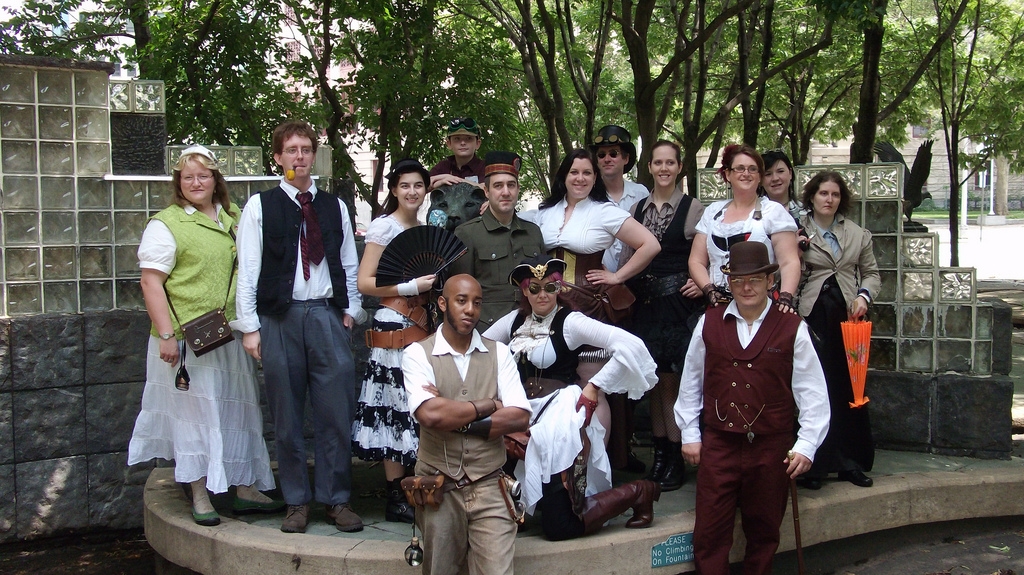
And here are a few photos of me and my friends at a recent invasion of the Santa Maria:

The Airship Archon group. We were posing with a lion statue in a fountain, but the lion got a bit lost!

Salena Van Eycke and I on the dock, about to board.

For more pictures of our adventures on the Santa Maria and at other events, you can visit my steampunk flickr set.

August Deadlines (and a little reflection)

Holy crap, it’s August!

Well, here are some upcoming deadlines for science fiction, fantasy, horror and steampunk publications that pay either royalties or at least $.01/word. Don’t forget to check last month’s post for deadlines that might still be fresh!

Corrupts Absolutely – deadline extended to December 1

On Spec Magazine – August 31

As you can see, I haven’t had any time this month to research deadlines. I’ve been dealing with too much other stuff, from work and school and everything else. So maybe next month will be better…

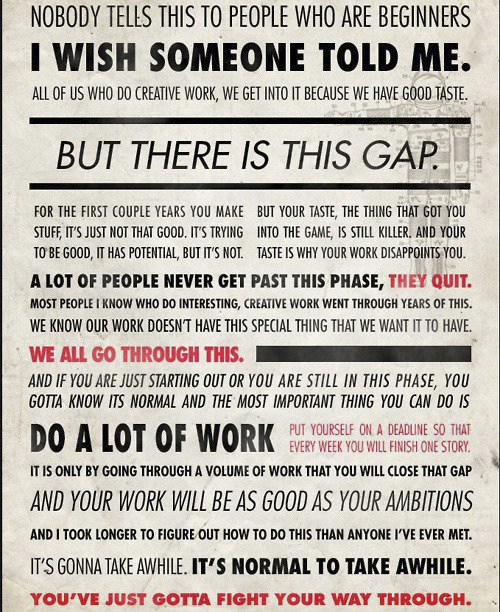
Here’s a thing that I really like, by Ira Glass, that Wil Wheaton posted on his Google+.

Originally from here. I’m taking a lot of comfort from this. I feel like my work is at a crossroads–I’m not as good as I want to be, and I’ve reached a sort of plateau. I can either keep writing and hope to push through, or give up. My writing is just Okay.  Occasionally I churn out something that’s Good but never Spectacular. The trouble is, there’s no road map for getting from Okay to Spectacular. All you can do is keep working, and growing, and trying to improve. Easier said than done–improvement is such a nebulous thing. But hopefully I’ll get there. Just have to “keep plugging,” as my Dad says.

Onwards and upwards! See you at GenCon!

The Crimson Pact: Volume One…In PRINT!

Exciting news: the publisher of The Crimson Pact is now producing print copies of the book!

It’s a beautiful book and I’m excited to see my story in print. It’s great that we’re going to be tapping into the market of hardcore print-only book lovers. I am, however, only ordering a few copies to start off with–I’m having a hard enough time selling copies of Historical Lovecraft, of which I ordered numerous print copies. People just don’t seem to be excited about spending $15 on a book at a con when they can purchase it as an ebook for less–and take up less room in the luggage they have to drag home!

Luckily, however, even if I never sell a single print copy, I’ll still see some dollars because of Alliteration Ink’s incredibly generous profit-sharing, which divvies up 75% of the profits among the authors. This is far more generous than most publishers and means that I see a small dividend every quarter, regardless of whether I succeed at selling the print books!

If you know you’d like to buy the print copy, please let me know so I can make sure to order one for you! I’ll probably be getting the copies from the publisher at Gencon.

Ba-Con in Review

Check out my review of Ba-Con at Doctor Fantastique’s Show of Wonders!

In related news, Tor’s steampunk division has a twitter account, and they retweeted my article. There are a lot of steampunks who read their tweets! Wooo! I’m sure I should be, I dunno, aloof and unimpressed or something, but I’m not, so there. Every time someone retweets a tweet of mine or comments on my blog or tells me they liked a story I wrote, I still get a thrill.

I hope that thrill never goes away!

Gencon Schedule

*this space left intentionally blank

Teehee!

For once, I’m going to a convention and not presenting a damn thing. No panels, no readings, no volunteering. Nada. And I’m super excited about it.

If you’re looking for me, though, my plan is to spend my days in the Writer’s Symposium. At night…well, we’ll see where the fun takes me, won’t we?

The only event I’m definitely  attending outside of the Writer’s Symposium is the Gencon Steampunk Meetup! Tell your friends!

Lessons from Rejection

The inevitable has finally happened: I’ve started getting rejections.

And lots of them.

Some editors have the time/consideration to tell me why they’re rejecting my work, which is really helpful, and others don’t bother. But so far I’ve noted a few things that are proving helpful (and preventing me from crying about it).

  • Some editors will hate what another loved. This lesson I learned from a podcast editor, who hated the things that made “Shadows of the Darkest Jade” a Lovecraftian story worthy of being included in a Lovecraft anthology in the first place. This might seem like an obvious lesson, but it made me laugh (in a bitterly ironic kind of way), so it’s worth mentioning.
  • Every high comes with a low. This is, again, a fairly obvious lesson …but everyone experiences an ebb in their popularity/success and this is (one of) mine. I just have to roll with it.
  • The more work you produce, the more criticism/rejection you’ll receive. This is just statistics. I’m not sure whether the quality of my work is suffering with quantity, though, so I think I’m going to dial back how many submissions I’m writing just so I can focus on writing better quality submissions.  If I churn out 20 crummy stories, they will all be rejected; it’s better to focus and produce 2 really excellent stories that actually have a chance of being published.
  • The more risks you take the more you’ll be rejected. My stories lately have been less linear and traditional. They’re a little harder to sell because they’re in unusual formats or have unusual points of view. It may be that these stories are simply impossible (or really difficult) to sell, and I’ll have to compromise and return to linear storytelling if I want to sell stories. I like challenging myself, so this is frustrating, but I understand that readers like linear, third-person storytelling. And maybe I’m just not that good at writing in unusual formats and POVs and I should wait until I’m a more skilled writer to try this challenge again.
  • Sometimes it’s good to focus on non-writing parts of the business. Yes, being a better writer is the most important goal I have, but I also do other things to promote myself (like write blog posts!) that are important. It may be that this time of year, while the sun is shining, is a better time for me to focus on the self-promotion aspects of the business than the writing part. I think my writing is better in the winter. I am, at least, more focused…summer is full of distractions!
  • Not every event/publication is appropriate for a particular author’s work. As an example, I had a frustrating time at Ba-Con this weekend, even though the convention itself was a blast, because my panels were not well-attended. It just wasn’t the right crowd for what I was presenting–and that’s okay. It was the con’s first year, so there was no way to know what the response would be like! The steampunk presentations I did with other members of the Airship Archon were much more popular, which was awesome, so I’m content with that.

So, while I’m frustrated with the rejections I’ve been receiving lately, I think I have ferreted out the causes, and my attitude remains positive and hopeful. I also take comfort from the fact that many other, far more accomplished and talented authors than I have received far more rejections. I’m in good company.